
A Hyper-Local Weather Platform Engineered for Scale, Resilience, and Community Communication
Research & Development White Paper / Living Case Study
DOCUMENT NUMBER: 300-01-USDSC-05-2026-IWW-WEB-KAS
Produced by: U.S. Digital Sciences Corporation (USDSC)
Lead Architect: Patrick Malkmes, CSE, ESE
Project: Islandwide Weather
Classification: Public Technical White Paper
Status: Living Document — Ongoing Research & Development
Last Updated: May 2026
Executive Summary
Islandwide Weather was conceived as a next-generation hyper-local weather platform designed specifically for Long Island, New York. The initiative began as a transformation effort to evolve a small social media weather presence into a resilient, independently operated digital media platform capable of serving severe-weather traffic surges while maintaining rapid delivery, real-time alerting, and operational continuity.
The system was architected and engineered by U.S. Digital Sciences Corporation (USDSC) utilizing a hybrid static/dynamic delivery model designed to withstand extreme traffic conditions without requiring large-scale infrastructure expenditure.
At its core, the project addresses several modern digital publishing and emergency communications challenges:
- Dependence on third-party social media algorithms
- High infrastructure costs during traffic surges
- Latency during severe weather events
- Fragmented weather data delivery systems
- Lack of localized weather content at town-level granularity
- Difficulties scaling traditional WordPress deployments
- Compliance requirements surrounding mass notification systems
The resulting platform combines:
- Edge-served static content delivery
- Real-time weather data hydration
- Distributed node architecture
- Queue-based communications systems
- Hyper-local SEO and GEO strategies
- Multi-layer security controls
- Weather-specific UX and seasonal branding systems
The project currently represents an active and evolving research and development initiative. The architecture, deployment strategies, caching methodologies, and data orchestration techniques documented herein continue to evolve as the platform scales.
Introduction
Modern weather delivery systems face a unique engineering problem:
The moments when weather information becomes most important are also the moments when traffic volume increases exponentially.
Traditional CMS-driven websites frequently fail during these conditions due to:
- Dynamic rendering bottlenecks
- Database contention
- Excessive origin requests
- Poor cache invalidation strategies
- Inability to separate static and dynamic workloads
Islandwide Weather was engineered to challenge this traditional model.
The platform was designed around a central premise:
"The majority of a weather website does not need to be dynamically rendered in real time."
Instead of serving every page request through PHP and MySQL, the system pre-renders and distributes HTML shells globally through Cloudflare while selectively hydrating only the portions of the page that require live weather data.
This approach dramatically reduces infrastructure requirements while maintaining the appearance and functionality of a fully dynamic application.
The result is a platform capable of sustaining substantial traffic spikes with comparatively modest infrastructure.
The Original Problem
Islandwide Weather originated from a small Facebook-based weather commentary page with approximately 200 followers.
While the audience was engaged, several operational limitations existed:
| Challenge | Impact |
|---|---|
| Audience owned by social platforms | Reach could be throttled algorithmically |
| No subscriber infrastructure | No emergency communication channel |
| No monetization path | No sustainable business model |
| No scalable infrastructure | Vulnerable during storms |
| Generic weather providers dominate search | Difficult organic visibility |
| No regional differentiation | Limited identity and retention |
USDSC approached the project as both:
- A production-grade deployment
- A long-term R&D initiative exploring scalable weather publishing architectures
Research & Development Goals
The engineering goals behind Islandwide Weather extended beyond launching a website.
The project explored the following technical objectives:
1. Edge-First Weather Publishing
Investigate how weather content could be delivered primarily from CDN edge nodes while minimizing direct origin interaction.
2. Static/Dynamic Separation
Separate:
- Static content rendering
- Dynamic weather retrieval
- Notification delivery
- Commerce processing
- Administrative tooling
Into isolated operational lanes.
3. Weather Data Aggregation
Combine multiple weather data sources into a unified presentation layer:
- National Weather Service
- NOAA
- NDBC buoy systems
- WSI/IBM weather feeds
- Marine and tidal data
4. Hyper-Local Forecasting
Create geographically targeted forecast pages for Long Island towns and communities.
5. Resilient Emergency Communication
Engineer a compliant notification system capable of delivering:
- SMS alerts
- Email alerts
- Severe weather banners
- Subscriber preference filtering
6. WordPress at Scale
Explore whether WordPress could function as a scalable content orchestration layer rather than a direct page-serving engine.
System Architecture Overview
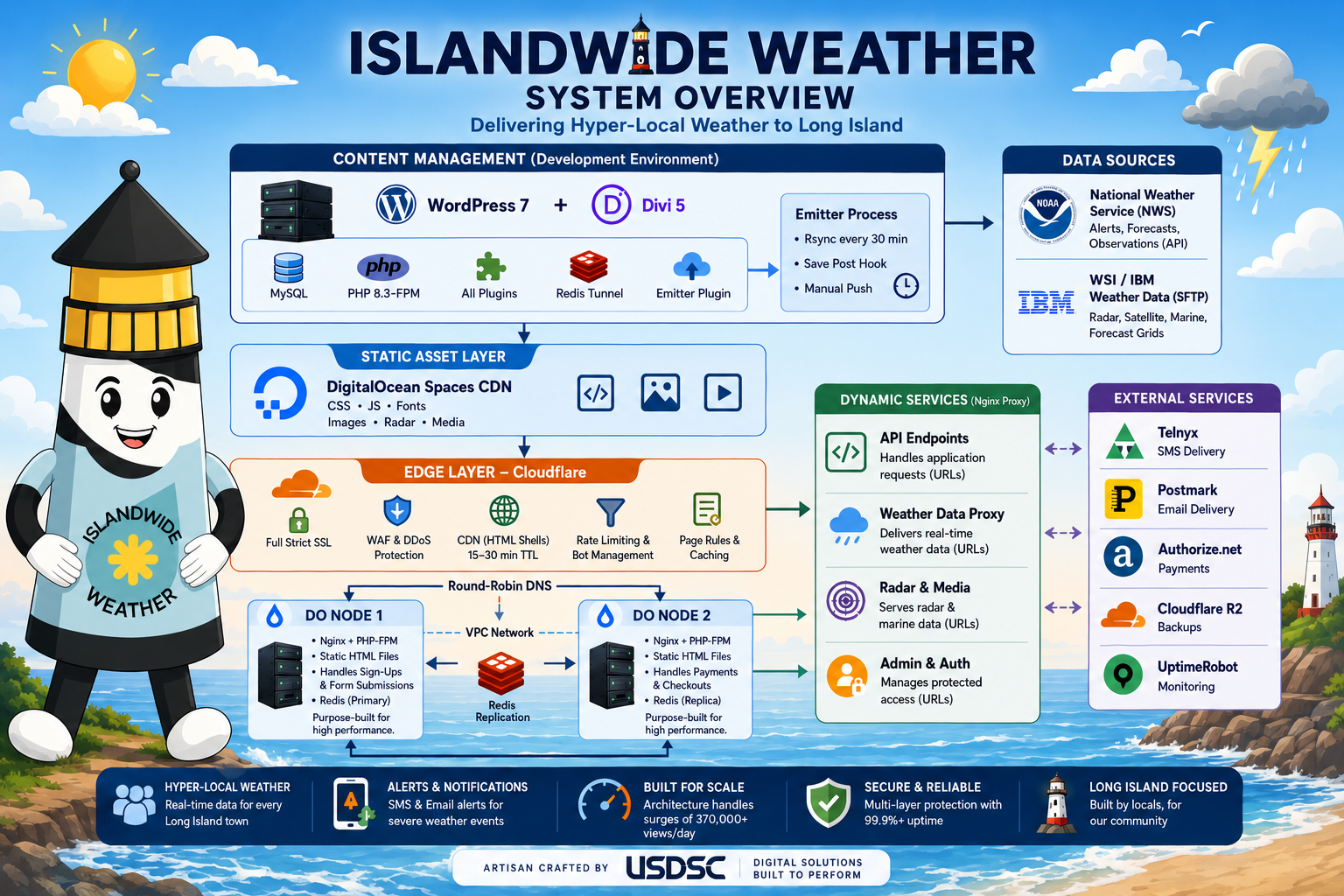
The Islandwide Weather platform utilizes a layered delivery architecture.
Core Layers
| Layer | Purpose |
|---|---|
| WordPress Development Layer | Content management and orchestration |
| Static Emitter Layer | HTML generation and synchronization |
| CDN Asset Layer | Global asset distribution |
| Edge Delivery Layer | Cached HTML shell delivery |
| Dynamic Service Layer | Real-time weather hydration |
| Communications Layer | SMS and email notifications |
| Queue Infrastructure | Asynchronous workload handling |
The architecture intentionally separates:
- Page rendering
- Weather retrieval
- User communications
- Commerce processing
- Administrative operations
This segmentation reduces the blast radius of individual subsystem failures.
Static Shell + Hydration Strategy
One of the most significant architectural innovations within the project is the use of static HTML shell delivery combined with JavaScript hydration.
Traditional weather websites frequently render:
- Current conditions
- Forecast data
- Widgets
- Menus
- Layouts
- Metadata
Through PHP on every request.
Islandwide Weather instead:
- Pre-renders pages into static HTML
- Distributes those pages to edge nodes
- Hydrates live weather components asynchronously after page load
This architecture produces several benefits:
| Benefit | Result |
|---|---|
| Reduced origin traffic | Increased scalability |
| Lower server utilization | Reduced operational cost |
| Faster page delivery | Improved UX |
| Better cacheability | Higher edge-hit ratios |
| Fault isolation | Improved resilience |
The platform therefore behaves more like a distributed application delivery network than a traditional WordPress website.
Weather Data Engineering
The weather delivery pipeline integrates several external systems while maintaining aggressive caching and normalization.
Data Sources
| Provider | Role |
|---|---|
| National Weather Service | Forecasts and observations |
| NOAA | Marine and tidal information |
| NDBC | Buoy and offshore conditions |
| WSI/IBM | Radar and weather graphics |
| Geolocation Services | ZIP and coordinate resolution |
A major engineering challenge involved reconciling:
- Observation station data
- Forecast grid data
- Geographic resolution mismatches
- Cache expiration timing
- API reliability concerns
The platform therefore employs:
- Multi-tier caching
- Transient expiration controls
- Normalized unit conversion
- Geographic lookup persistence
- Fallback alert mechanisms
Emergency Communications Infrastructure
The platform includes a dedicated weather notification system engineered for:
- TCPA compliance
- CAN-SPAM compliance
- Subscriber filtering
- Queue-based dispatch
- Delivery confirmation tracking
- Opt-out management
Notification Channels
| Channel | Provider |
|---|---|
| SMS | Telnyx |
| Postmark |
The system was designed to support severe weather communication workflows without requiring manual infrastructure intervention during emergencies.
This includes:
- Queue-driven asynchronous delivery
- Delivery status tracking
- Subscriber segmentation
- Automated severe weather banner activation
The communications architecture was intentionally decoupled from frontend delivery to ensure alert continuity even during elevated traffic conditions.
Security Engineering
Security was treated as a foundational architectural concern rather than an afterthought.
The system implements multiple defensive layers including:
- Cloudflare WAF controls
- Geographic filtering
- Rate limiting
- Dynamic application isolation
- WordPress administrative segregation
- Queue isolation
- Secure API token handling
- Static content distribution
- Redis private networking
The architecture intentionally minimizes direct attack surfaces.
Examples include:
- No direct exposure of internal APIs
- Administrative isolation from production rendering
- No raw card data touching the server environment
- PHP execution restrictions outside defined areas
- Edge-first request handling
The project also incorporates OWASP-aligned development methodologies and infrastructure hardening procedures.
SEO, GEO, and AI Readiness
Islandwide Weather was not designed solely as a weather application.
It was also engineered as an experiment in:
- Geographic search dominance
- AI answer engine discoverability
- Structured data optimization
- Hyper-local content generation
The platform includes:
- Structured schema layers
- Town-level landing pages
- Geographic keyword targeting
- Forecast-specific metadata
- AI-readable semantic structures
- Long-tail geographic indexing strategies
The project also serves as a production case study for USDSC's broader Generative Engine Optimization (GEO) methodologies.
Seasonal Identity & UX Research
An unusual but important component of the project involved studying emotional engagement within weather delivery systems.
The Islandwide Weather experience incorporates:
- Seasonal themes
- Animated environmental effects
- Event-based visual state changes
- A lighthouse mascot named Beacon
- Dynamic severe weather branding
The objective was to determine whether weather presentation could evolve from purely informational into a recognizable and emotionally engaging regional identity.
This aspect of the project continues to evolve.
Performance & Scaling Philosophy
A major research focus involved determining how far edge-cached publishing could scale before requiring significant horizontal infrastructure expansion.
The architecture was specifically designed around:
- Minimal origin interaction
- CDN-first delivery
- Aggressive cache utilization
- Asynchronous processing
- Lightweight API hydration
At the time of this writing, the platform is engineered with the goal of supporting:
- Major severe weather traffic spikes
- Regional event surges
- Mobile-heavy traffic patterns
- Simultaneous communications dispatches
Without requiring large-scale compute clusters.
This research remains ongoing.
Patrick Malkmes — Lead Architect
Patrick Malkmes served as the lead architect, systems engineer, and security engineer for the Islandwide Weather initiative.
With decades of experience spanning:
- Systems architecture
- Software engineering
- telecommunications
- infrastructure design
- cybersecurity
- application delivery
- cloud systems
- real-time communications
Patrick approached the project as both a deployable product and an engineering research initiative.
His work on Islandwide Weather focused heavily on:
- Edge-first infrastructure strategies
- Distributed weather publishing
- resilient application delivery
- WordPress orchestration methodologies
- queue-based communications systems
- layered security architecture
- scalable content emission pipelines
The project reflects USDSC's broader philosophy that modern digital systems should:
- degrade gracefully
- scale economically
- minimize complexity where possible
- separate operational responsibilities
- remain understandable and maintainable over time
Islandwide Weather also represents a continuation of Patrick's ongoing research into:
- high-performance publishing systems
- AI-ready web architectures
- geographically targeted content systems
- operational resiliency
- human-centered technical experiences
U.S. Digital Sciences Corporation
U.S. Digital Sciences Corporation (USDSC) is a technology engineering and research company specializing in:
- custom software engineering
- infrastructure architecture
- AI-enabled systems
- cloud operations
- cybersecurity
- telecommunications systems
- large-scale web platforms
- digital transformation
The Islandwide Weather initiative serves as a public-facing example of USDSC's architectural methodologies and engineering philosophy.
More information can be found at:
Lessons Learned
Several important lessons emerged during the early phases of development.
1. WordPress Can Scale When Repositioned
WordPress performs significantly better when used as:
- a content orchestration system
rather than:
- a real-time rendering engine.
2. Weather Platforms Require Operational Segmentation
Separating:
- weather retrieval
- rendering
- notifications
- commerce
- administration
Improves both resilience and maintainability.
3. Edge Delivery Changes Economics
Serving weather pages from edge cache dramatically reduces infrastructure requirements during storms.
4. Local Identity Matters
Hyper-local branding and town-specific forecasting substantially increase engagement and differentiation.
5. Simplicity Often Wins
Several architectural decisions intentionally favored:
- reliability
- maintainability
- operational clarity
Over unnecessary abstraction.
Future Research Directions
The project remains active and continues to evolve.
Current areas of ongoing exploration include:
- Live radar integration enhancements
- Mobile application expansion
- AI-assisted weather summaries
- Predictive alert ranking
- Enhanced marine forecasting
- Regional severe weather clustering
- Automated content synthesis
- Distributed multi-region failover
- AI-assisted infrastructure monitoring
- Event-driven scaling methodologies
Additional architectural refinements are expected as traffic patterns and operational demands continue to mature.
Living Document Notice
This document represents an active and evolving technical case study.
The Islandwide Weather platform remains under continuous development, refinement, and operational analysis.
Architectural strategies, deployment methodologies, security controls, scaling procedures, and subsystem implementations documented herein may evolve over time as new findings emerge.
This white paper should therefore be considered:
- a technical snapshot
- an engineering journal
- a deployment reference
- a living R&D document
Rather than a final or immutable specification.
Conclusion
Islandwide Weather demonstrates that modern hyper-local publishing systems can achieve substantial scale and resiliency without requiring massive infrastructure investment.
By combining:
- edge delivery
- static emission
- dynamic hydration
- queue-based communications
- layered security
- AI-ready content strategies
USDSC engineered a platform capable of serving both operational and community-focused objectives.
The project continues to serve as an ongoing research initiative exploring the future of:
- weather publishing
- scalable WordPress orchestration
- geographic information systems
- resilient communications
- distributed content delivery
- AI-integrated web infrastructure
As the platform evolves, this document will evolve alongside it.
References
Primary Technical Reference:
Islandwide Weather — Full Platform Build Specification
- Distributed Weather Infrastructure
- AI-Assisted Forecast Systems
- Operational Middleware
- Infrastructure Resilience
- Cloud Edge Architecture
- High Availability Systems
- Weather Intelligence Platforms
- Scalable Operational Systems
Research Methodology
This research initiative follows a systems-first engineering
methodology focused on iterative infrastructure development,
operational resiliency, distributed forecasting architecture,
and AI-assisted workflow optimization.
The Islandwide Weather platform is being developed through
a phased engineering model involving:
- Infrastructure prototyping
- Edge distribution testing
- Operational telemetry collection
- Forecast ingestion validation
- AI-assisted alert workflow analysis
- Scalability and redundancy modeling
CONGRAT'S YOU FOUND THE EASTER EGG AND SOME GOOD READING! Happy Surfing ~ PM